
2026 Allulose Review: What It Is and How To Use It Right
Updated: 11 minutes ago
By Adriane Campos, chemical engineer and food technologist.
Have you ever heard of allulose—a sugar that delivers sweetness without the calories or blood sugar spike? If not, you’re not alone. Allulose is a relatively new sweetener gaining attention for its culinary benefits and natural origin. But what is it, exactly? Does the research actually support the claims that allulose can help reduce post-meal blood sugar spikes, increase satiety, and promote weight loss?
Sweeteners can be controversial. Some have decades of research behind them; allulose doesn’t yet. That's why I wanted to take a careful, evidence-based look at it. In my quest to help home cooks navigate the complex world of sugar alternatives, I wrote this blog post to bring together the questions we’ve received from the WhatSugar® community. You'll find 60+ science-backed facts in a format that’s easy to skim or explore in depth, and it continues to grow as new questions come in.
This post is organized by topic:
🟢 PART 1: Allulose Basics - What is allulose?
- Why allulose isn't "zero sugar" - Where allulose comes from - Why choose organic allulose
- What type of sweetener is allulose? 🟢 PART 2: Allulose & Health
- Allulose digestion & metabolism
- Allulose carb count & label claims
- Safety of allulose - Allulose side effects
- Allulose & blood sugar control
- How much to use for benefits
🟢 PART 3: Choose & Use Allulose
- Allulose taste & sweetness level - Allulose in baking & cooking
There is A LOT to unpack below. Explore it all or, if you are short on time, refer to the pros & cons at the end of this post. You can also visit my complete 2026 Guide to Buying Allulose.

New here? Scroll all the way down to the section About WhatSugar® for a quick intro to what we do.
Is Allulose a Chemical?
Yes. Chemically speaking, allulose is a simple carbohydrate known as a rare sugar.
What are rare sugars? The term rare sugars refers to a subgroup of simple sugars (monosaccharides) that exist in very small amounts in nature. Researchers in Japan popularized the term through the Rare Sugar Research Center at Kagawa University. The center played a major role in researching allulose — known as D-psicose — after discovering how to produce it on a commercial scale via enzymatic methods from fructose.
Allulose isn't a new chemical. Even though allulose was not commercially available as a sweetener until the last decade, it has been consumed historically, though not in meaningful amounts. Tiny amounts of allulose can form naturally when foods and drinks containing fructose (or sucrose) are processed and heated. The estimated dietary intake of allulose naturally present or formed in foods is 280–700 mg per day for a 70 kg (150 lb) adult. To give you a sense of scale: 1 teaspoon of pure allulose sweetener contains about 4 grams (4,000 mg).

Is Allulose "Zero Sugar"?
Not exactly.
Allulose is technically a sugar, just not a typical one. It is different from what we traditionally think of as sugar — like table sugar (sucrose), glucose, and fructose. Although allulose shares the same chemical formula (C₆H₁₂O₆) as glucose and fructose, the image above shows its atoms are arranged slightly differently. Allulose structure is uncommon in nature (which is why it’s called a rare sugar), and is metabolized differently compared to sugars that are common in nature.
The Food and Drug Administration (FDA) refers to allulose as a non-traditional sugar, which means it is treated differently than common sugars on the Nutrition Facts label — in terms of Calories, Total Sugars, and Added Sugars. Allulose must be included in Total Carbohydrate but not in Total Sugars or Added Sugars. And unlike traditional sugars, which contribute 4 calories per gram, allulose contributes only 0.4 cal/g. I explain why later in this post, in Why Does Allulose Seem to Break All the Usual Nutrition Label Rules?
Allulose creates an unusual labeling situation: it can show 0g Total Sugars and 0g Added Sugars, but since it is still a sugar, it is not "Zero Sugar". The FDA allows allulose to be excluded from Total Sugars and Added Sugars in the Nutrition Facts panel (learn why here). This comes from a guidance — through what FDA calls "enforcement discretion" — rather than a change to the official regulation. Here’s the catch: allulose is still chemically a sugar and under FDA rules, one requirement for a "zero sugar" claim is that the product cannot contain any ingredient that itself is a sugar. 🤔 Now you can see why this gets confusing: if the Nutrition Facts panel says 0g Total Sugars, it seems logical that “Zero Sugar” or "0g Sugar" claims are okay. But the FDA treats these separately: its allulose guidance addresses how allulose is reported in the Nutrition Facts panel, while a separate FDA regulation sets the requirements for claims such as “Zero Sugar.” That distinction is at the heart of the recent lawsuits.
Marketing products containing allulose with "Sugar-Free" or "Zero Sugar" claims have become the target of lawsuits. Chobani was sued over its “Zero Sugar” yogurt and in July 2026 a federal appeals court ruled that allulose is a sugar under FDA regulation and allowed the consumer-deception case to proceed. More recently, Wholesome Yum sweeteners, Monin syrups, Liquid I.V. drink mixes, Liquid Death energy drinks, DAVID protein bars, and Grüns gummies were hit with a proposed class actions. Some face multiple lawsuits, like Wholesome Yum, DAVID, and Grüns. Meanwhile, consumer law firms are seeking purchasers of products promoted as “Zero Sugar” like RxSugar and even running ads on social media.
Alulose often gets the nickname "the sugar without the calories." It isn't truly zero-calorie like high-intensity sweeteners such as sucralose, stevia leaf extract, and monk fruit extract. But, by law, a product can be labeled zero-calorie if it provides fewer than 5 calories per serving, which can be rounded down to zero. RxSugar has faced challenges over its allulose labeling and marketing, and learned how important serving size is. The FDA issued them a warning letter questioning its serving sizes and “0 Calories” labeling. The FDA calculated 10 calories per serving using the correct serving size and allulose's 0.4 calories per gram.
Allulose has been referred to as “pseudo-fructose” because it closely resembles fructose. But their similarities go beyond molecular structure (shown above). Here are five shared features between allulose and fructose: (1) molecules differ only in the orientation of one hydroxyl group (2) similar behavior in the kitchen (check out the comparison section) (3) absorption in the small intestine via the same transport pathways (4) potential to trigger or affect GLP-1 secretion (details ahead) (5) limited tolerance, with digestive issues beyond it (explained later). Fructose is one of the two sugars that make up table sugar (see image below), so allulose's behavior isn’t unusual. Despite these similarities, allulose behaves very differently from fructose in the body in five key ways: (1) provides only 0.4 cal per g, compared to 4 for fructose (2) offers 0g of total sugars, versus 4g per teaspoon for fructose (3) doesn't raise blood sugar or insulin levels like fructose (4) isn't converted into fat in the liver, unlike fructose, which can be with high intake (5) hasn't been linked to weight gain or metabolic diseases, while fructose in excess has.
Is Allulose Considered Natural or Artificial?
Allulose is considered a natural sweetener, based on the FDA's longstanding policy, which, in essence, means that natural ingredients are those that exist in nature AND are derived from natural sources. While the FDA acknowledges that some natural ingredients can be "manufactured artificially" — as is the case with allulose — here at WhatSugar®, we refer to those ingredients as synthetic for clarity, as they're not directly isolated or extracted from a natural source.
Why does allulose have to be "manufactured artificially"? Allulose is found in nature, but only in tiny amounts in foods such as raisins, dried figs, kiwi, brown sugar, molasses, wheat, and maple syrup. How tiny are we talking about? Allulose amounts are usually way below 1%. If you eat about 3½ ounces (100 g) of these foods, this is how much allulose you’d get:
Higher (still very small): 🍶Worcestershire sauce~130 mg 🍁Brown sugar, maple syrup<70mg 🍇Dried figs, raisins~30–40 mg
Moderate:
🥤Sugary drinks~20–40 mg 🥫Ketchup~40 mg
Very low:
🍪Cookies~5–30 mg
☕️Coffee~0.5 mg For perspective: 1 teaspoon of pure allulose contains about 4 grams (4,000 mg). Compare that to natural sources, which contain 0.5–130 mg per 3½ oz (100 g) — hundreds of times less.
Because sources in nature contain too little allulose for extraction, store-bought allulose is not derived directly from them. Instead, for large-scale production, it's synthetically made from corn or other inexpensive fructose sources, such as sugar beets.
How can a natural sweetener be synthetic? 🤔 Because, according to the FDA, “natural” refers to the ingredient itself — not how it’s produced. The allulose found in nature and the allulose produced commercially are identical. In other words, the store-bought version has the exact same chemical structure as the allulose that occurs naturally in the foods listed above, so it is still considered a natural ingredient even though it’s made through a manufacturing process.
The FDA uses vitamin C (ascorbic acid) as an example to explain that: it can come from an orange or be produced in a laboratory — the end molecule is the same. One is intrinsic in the food, and the other is a synthetic copy. Allulose works the same way — it is intrinsic in the foods listed above or can be produced from corn. Synthetic copies are natural.
How can a sweetener be synthetic, but not artificial? 🤔 According to the FDA, artificial ingredients refer to compounds not found in nature. So, allulose derived from corn — the synthetic one — is not considered artificial as it’s indistinguishable from the allulose that occurs naturally in the foods listed above.
If this raised questions about what natural means, these two posts are a great next step: 👉 Natural Sweetener: Not What You Might Think 👉 5 Misconceptions About Natural Sweeteners
What Is Allulose Made From?
None of the natural sources is used to produce the store-bought allulose. Allulose is found in wheat, fruits, and many other foods, but only in minuscule amounts. As natural sources contain very small amounts of allulose, large-scale production from them is not cost-effective.
Store-bought allulose is made from fructose derived from corn — or other inexpensive sources of fructose, such as sucrose from sugar beets — because it allows to produce allulose more economically, with higher purity, and more consistency. Europe produces allulose from sugar beets, but most products sold in America come from corn. The process involves four key steps:
(1) Starch extraction – Starch is isolated from corn
(2) Hydrolysis – Enzymes break down starch into glucose
(3) Isomerization – Glucose is converted into fructose by enzymes
(4) Epimerization – Enzymes convert fructose into allulose.
If the allulose is certified organic, the fructose used to make it must come from organically grown, non-GMO corn. Organic allulose must be sourced from corn grown in accordance with USDA organic standards (the National Organic Program or NOP). Genetically modified (GM) seeds are not allowed. In addition, organic allulose cannot be produced using enzymes from genetically modified microbes. Read more about this in my Guide to Organic Sweeteners.
For more details on how allulose is made, refer to the GRAS notices submitted by manufacturers for FDA review HERE — click "D-psicose" in the "Substance" column, and download the PDF for each notice.
Where Do I Buy Allulose Made From Figs?
Looking for which brands of allulose are extracted from figs or raisins? The answer is none. Be cautious of misleading claims. Some brands falsely claim their allulose comes from figs, raisins, or jackfruit, such as THIS. In reality, commercial allulose is not extracted directly from these fruits.

Organic Allulose: Is It Worth Buying?
Yes — and it matters more for allulose than most people realize. I list 15 solid reasons why organic matters for sweeteners in general in THIS post, but here are the top 5 reasons specific to allulose:
A certified organic allulose undergoes greater scrutiny — far beyond what’s required for a non-organic. Conventional sweeteners only need to meet the FDA's regulations for labeling. Organic sweeteners, however, must comply with both FDA’s law and a long list of additional requirements under USDA’s organic standards. This added layer of regulation ensures stricter rules than conventional allulose.
Organic certification ensures that every participant in the supply chain is accountable — not just the brand on the label. That's because everyone involved in producing and selling organic allulose must be certified: the farmer, the processor, co-packers, distributors, and any other handlers. Why does that matter? Much of the world’s allulose supply is produced in Asia, so it moves through multiple steps and facilities before reaching you. For allulose to carry the organic seal, every entity involved must meet specific, rigorous standards.
Organic farmers are required to use practices that maintain or improve soil and water quality — while also protecting wetlands, woodlands, and wildlife. Organic methods are also designed to minimize exposure to synthetic pesticides and fertilizers. For example, glyphosate, the most widely used herbicide in the U.S., especially on corn, is strictly prohibited in organic farming. Allulose derived from conventional corn may contain trace residues, even after purification. Organic allulose avoids this from the start. That difference runs from farm to final product—and it matters for both you and the planet.
If the allulose is organic, it is non-GMO. The use of genetic engineering or genetically modified organisms (GMOs) is prohibited in organic products. Organic allulose cannot come from GMO corn, nor can it be made using enzymes derived from GM microbes. Many of my readers express concern about the unknown consequences of genetic engineering, so this offers them extra peace of mind.
Organic standards restrict the use of many synthetic processing aids commonly used in conventional allulose production. Conventional allulose is often refined using synthetic processing aids, such as ion-exchange resins. Organic standards place tighter limits on how the ingredient is purified and only allow specific substances listed on the National List of Allowed and Prohibited Substances.
These are just some of the advantages. Learn more by reading my post: Organic Sweeteners Buying Guide.
✨ Over and over, home cooks told me the same thing: they don’t just want a sugar alternative — they want reassurance. They want to know their sweetener is free from artificial ingredients, GMOs, and questionable pesticides.That need for reassurance shaped how I approached developing an organic allulose option. I explain how this shows up in real products later in this post, in the section Which Brand of Allulose Is Best?

What Type of Sweetener Is Allulose?
From the FDA's view, allulose is a natural sweetener because it is derived from a natural source AND is found in nature. In addition, the FDA explains that some ingredients "found in nature can be manufactured artificially and produced more economically, with greater purity and more consistent quality, than their natural counterparts." Allulose is an example of this.
Based on the way it is produced, allulose is best described as a synthetic sweetener — rather than the FDA's awkward description of it as a "natural sweetener manufactured artificially." The allulose sold in stores is essentially a "natural sweetener-like" ingredient: a synthetic copy of the allulose found in nature. A useful comparison comes from the FDA’s example of vitamin C (ascorbic acid), which can be derived directly from an orange or produced artificially in a laboratory through fermentation. The version made in the lab is synthetic.
Allulose is a GMO-free sweetener. Its molecule is identical whether it comes from GMO plants or not. So, any conventional allulose can be labeled as non-GMO, even if it comes from GM crops and enzymes. Organic allulose, on the other hand, must be documented at every stage — how the plant was grown, how it was processed, how it was handled, and how it was packaged. That gives certified organic a higher level of trust that it was not made from GMO corn and by enzymes derived from GM microbes.
A good example of this is Truvia Allulose. It’s conventional (non-organic) allulose made in the U.S. from GMO corn and processed with enzymes from genetically engineered microbes. Once refined, it no longer contains any traces of GMOs and may even carry a "non-GMO" icon on its label.
Allulose is a bulk sweetener because it can add weight and volume to foods, impacting mouthfeel and texture like table sugar. Unlike bulk-free sweeteners, which are used whenever sweetness is all you need, allulose does far more than just offer a sweet taste; it also helps thicken your foods and bind ingredients. Learn more here: Bulk-Free vs Bulk Sweeteners.
The FDA has not explicitly classified allulose as a sugar-free sweetener: According to FDA labeling guidance, allulose does not count toward “total sugars” or “added sugars” on nutrition labels. However, under FDA rules, a product can only be labeled “sugar-free” if it contains fewer than 0.5 g total sugars per serving AND is not chemically a sugar. Because allulose is still a sugar, using a straightforward “sugar-free” claim is not clearly supported.
According to the FDA's food labeling regulation, allulose is a zero-calorie sweetener. As I break this down in the section What Does Allulose Do to the Gut?, even though we cannot metabolize allulose, bacteria in the large intestine can, and we obtain their energy indirectly. The FDA assumes 0.4 cal/g (10% that of table sugar). It means 1.6 calories per teaspoon (4g), 75 calories per cup (48 tsp; 192g). So, allulose isn't truly zero-calorie like high-intensity sweeteners such as sucralose, stevia, and monk fruit. But by law, it can be labeled as zero-calorie because it provides a small amount of calories — less the 5 — per serving, which can be rounded to zero. For reference, the serving size for allulose in store-bought sugar alternatives is 1 tsp (4g) or 2 tsp (7–8g).
🎯 Allulose calories: 0.4 cal/gram = 1.6 cal/tsp = 75 cal/cup.
📌 Table sugar (sucrose): 4 cal/gram = 15 cal/teaspoon = 770 cal/cup
In WhatSugar's perspective, allulose is a reduced-calorie sweetener. Here's why. Allulose's real calories: Allulose has about 1.6 calories per teaspoon, but it’s only 70% as sweet as sugar. To match the sweetness of sugar, you need more of it. That means the real calories per “sugar-level sweetness” are closer to 2.3 calories, not 1.6. For example, replacing 1 cup of sugar with allulose would require 1.4 cups, bringing the total to 110 calories instead of 75. While allulose does offer significantly fewer calories than sugar—since one cup of sugar has 770 calories—it's not actually zero-calorie.
Allulose is approved as a nutritive sweetener. According to FDA regulations, a nutritive sweetener provides more than "2% of the caloric value of sucrose per equivalent unit of sweetening capacity." What's the "equivalent unit of sweetening capacity"? It means the amount needed to match the sweetness of sugar—not the same weight or volume. In kitchen terms, one teaspoon of sugar (4 calories) is equivalent in sweetness to 1.4 teaspoons of allulose (2.3 calories). The FDA’s 2% cutoff equals 0.08 calories per teaspoon. Since allulose exceeds that, it’s classified as nutritive under FDA rules—even though its calorie content is far lower than sugar’s and it's listed as zero on nutrition labels.

Isn't Allulose a Highly Processed Food?
A concern I hear is this: Isn’t allulose a highly processed food and thus can be grouped with packaged foodstuffs that have less healthful value than whole foods?
Allulose is a processed ingredient. However, I wouldn’t put allulose in the same category as ultra-processed foods like ready-to-eat, shelf-stable packaged foods. Allulose is just one ingredient, not a mix of additives, preservatives, and flavors.
So, under food classifications like NOVA, allulose would likely fall into the processed culinary ingredients category, obtained from nature and used to prepare homemade meals. It’s used in small amounts to sweeten foods at home—coffee, tea, baking, and cooking. And like all sweeteners, it’s best used sparingly and alongside whole foods.
👉 Unlike ultra-processed foods and added sugars — both associated with weight gain and metabolic diseases — allulose hasn’t been linked to these outcomes.
It's true that allulose isn’t a whole food, but it’s also not trying to be one. It’s simply a tool to help people enjoy a sweet taste without the downsides of common sugars (including less-processed forms like honey, maple syrup, and unrefined sugars). Allulose has almost zero calories and contains 0 g of sugar.
While whole foods will always be the foundation of a healthy diet, allulose can play a supportive role—especially for people managing diabetes, watching their weight, or reducing added sugar.
What Does Allulose Do to the Gut?
Does the body digest allulose?
After reviewing the totality of the scientific evidence, here's what FDA concluded about how the body handles allulose:
Allulose goes through a fast & partial absorption in the small intestine: About 70% of the allulose we consume is rapidly absorbed (within 1 hour) in the small intestine and passes into the bloodstream. The kidneys remove allulose from the bloodstream, and it is cleared from plasma in 24 hours — eliminated intact [without any decomposition] in urine. Consuming allulose with foods slows absorption.
Bacteria metabolize allulose in the large intestine: About 30% of the allulose we eat — the portion not absorbed in the small intestine — is transported to the large intestine, where it is "poorly" fermented in the large intestine, providing no more than 0.4 kcal/g. It means that allulose may be fermented or excreted unchanged in feces. The low caloric value of allulose stems from the fact that microbes metabolize it, and we obtain its energy indirectly. So, even though we cannot metabolize it, bacteria in the lower digestive tract can. Because of that, allulose still provides 5 to 10% of their calories of common sugars. Based on this evidence, the FDA determined that allulose is minimally metabolized in the human body.
For the portion of allulose that isn’t absorbed, here’s what can happen in the large intestine:
Gas production and flatulence from allulose: Allulose may be fermented and result in the production of gases and short-chain fatty acids (SCFA). SCFAs such as acetate, propionate, and butyrate are absorbed and contribute energy.
Laxation from allulose: The amount of allulose that enters the large intestine, which happens quickly after ingestion, may act osmotically by drawing water from the body, causing loose stools or diarrhea.
How Much Allulose Is Too Much?
The potential for D-allulose to cause a laxative effect is well documented. If you want to know what “too much” actually looks like in practice, you're in the right place.
Our bodies can easily break down and digest common sugars, but not rare sugars. Like sugar alcohols (polyols), rare sugars are classified as low-digestible carbohydrates. Some of the amounts we ingest pass INTACT into our large intestine, where they may be fermented by gut bacteria and may act osmotically by drawing water from the body, causing gastrointestinal issues.
Allulose is self-limiting for most people: One upside of allulose is that if you have too much, your gut will warn you fast, long before it becomes a habit of overdoing it. That feedback helps most people naturally stay within their personal comfort zone.
Wondering if the FDA looked at how much allulose people could consume before laxative effects were consistently observed? Yes—this is what’s referred to as a No Observed Adverse Effect Level (NOAEL). However, this is not a promise that everyone will tolerate that amount. The FDA reviewed both animal and human data in allulose's GRAS notices, including a study by Iida et al. (2007), and accepted the reported NOAEL in grams per kg of body weight (bw) per day:
👨🏻⚖️ Allulose NOAEL for men = 0.5 g/kg bw/d
👩🏻🦰 Allulose NOAEL for women = 0.6 g/kg bw/d
For a 70-kg (about 150-lb) adult, this corresponds to up to 35–42 g of allulose (roughly 8–10 teaspoons) consumed throughout the day — incorporated into foods, not as a single dose. Women may tolerate slightly more than men. ⚠️This does not mean symptoms are impossible below that level. Everyone’s tolerance is different—see the allulose digestive issues section below for a practical breakdown.
CSPI wants a digestive issue warning. The Center for Science in the Public Interest has questioned whether these values fully reflect real-world tolerance among the general population and among more vulnerable groups. The group has urged the FDA to require a warning label, citing concerns about digestive side effects. According to their analysis, gastrointestinal symptoms such as bloating, nausea, and diarrhea were reported even at lower doses (around 0.1 g/kg body weight). That's roughly 1½–2 teaspoons for a 150-lb adult.
A laxative-effect warning is required in 🇳🇿 New Zealand and 🇦🇺 Australia. To reduce the risk of a laxative effect, FSANZ recommended that consumption of allulose not exceed 0.4 g/kg body weight in a single serving. It means 28g or about 7 teaspoons for a 70 kg (154 lb) adult. This aligns with human tolerance data by Han et al (2018). Because some foods deliver more allulose than that in a single serving, a laxative-effect warning is required in the following foods: 🍰Bakery products
🍬Chewing gum
🥣 Breakfast cereals
🍮 Desserts (including gelatin)
🍨 Ice cream and frozen desserts
🧃Flavored non-alcoholic drinks
🥛Yogurt (including frozen)
How much allulose do people typically consume vs what's tolerated: 🇺🇸 In multiple GRAS notices for allulose, it was estimated that the daily intake of allulose could reach 2½ tsp to 7–8 tsp (about 2½ Tbsp). GRAS Notice 1057 modeled real-world intake of allulose across many foods. It estimated how much allulose people might realistically consume once it’s widely used across many food categories. It confirmed that digestive comfort is the main practical limit. Using U.S. dietary data (NHANES), the estimated daily intake of allulose as a sugar replacement is between 10 to 25 g per day (for 70 kg or ≈150 lb adults): 🔹Mean intake: 0.15 g/kg bw/day = 10.5 g/day ≈ 2½ tsp/day 🔺Heavy consumers: 0.35 g/kg bw/day = ~25 g/day = ~6 tsp 🇦🇺 What Australia & New Zealand estimated (FSANZ). Based on proposed uses of allulose in foods, regulators estimated the following daily intakes (calculated for a 70 kg or ≈150 lb adult):
🔹Average intake: 0.160 g/kg bw/day = 11 g/day ≈ 2½–3 tsp/day
🔺High intake: 0.730 g/kg bw/day = 51 g/day ≈ 12–13 tsp/day
Why Does Allulose Seem to Break All the Usual Nutrition Label Rules?
If allulose is listed as a carb and is a sugar, why doesn’t it raise blood sugar, add calories, or count toward net carbs? The answers come down to how labels work versus how the body works. Allulose doesn’t actually break nutrition label rules—it just exposes the gap between what labels are required to show and how your body really processes food.
Let's dig deeper.
Why is allulose counted as carbs?
Want to know why allulose is listed in "Total Carbohydrate"? Shouldn't allulose get subtracted from carbs?
Technically, allulose is a carbohydrate and counts towards the "total carbohydrate" on the nutrition facts label. Here's what the FDA states: Carbohydrates are declared on the nutrition label based on their chemical structure, not on their physiological effect (such as raising blood sugar levels or causing laxation). It means carbohydrates are grouped by chemistry, not by what they do in your body. That’s why sugar, fiber, sugar alcohols, and allulose can all appear under “Total Carbohydrate,” even though their effects are very different. Total Carbohydrate is calculated, not directly measured. It’s determined by taking the weight of the food and subtracting protein, fat, water (moisture), and minerals (ash). Whatever remains is counted as carbohydrate. That’s why allulose still appears under “Total Carbohydrate” on labels.

How come allulose is a sugar, but it doesn't have calories?
Allulose is a sugar without calories; yes, you heard that right. Based on the review of the evidence, the FDA concluded that allulose provides very few calories — 0.4 kcal/g — because most of the allulose we consume (around 70%) is absorbed and excreted unchanged in the urine, while the remaining ~30% may be fermented in the gut or excreted in feces.
Should I track allulose if I’m counting calories? It depends on how much you're using. While allulose does offer significantly fewer calories than sugar—since one cup of sugar has 770 calories—it's not actually zero-calorie. Per serving (often 1 or 2 teaspoons), the calories are low enough to legally be rounded down to zero, but they add up when measured in cups (48 teaspoons). Allulose has 75 calories per cup. Because it's less sweet than sugar, replacing 1 cup of sugar with allulose would require 1.4 cups, bringing the total to 110. 👉 Allulose offers far fewer calories than sugar. If you’re using a teaspoon here and there, the calorie count is almost negligible. But if you’re measuring by the cup, those hidden calories start to matter.
Should I track allulose if I’m counting carbs?
No. Allulose won’t impact your carb count. Allulose is a great choice for low-carb and keto diets.
Does allulose count in net carbs? No, allulose has zero net carbs. As mentioned before, allulose is a carbohydrate and counts towards the "total carbohydrate", but it offers zero net carbs because it's not available for digestion. Net carbs are digestible carbs that break down into glucose and raise blood sugar levels. One serving of allulose [which is 1 teaspoon and weighs 4g] contains 4g of non-digestible carbohydrates, which means it offers zero "net carbs."
How net carbs are calculated matters. Net carbs aren’t what’s printed on the Nutrition Facts label. They're the carbs your body can actually use — often called available, counting, or digestible carbs. Since allulose is classified as a carbohydrate on the Nutrition Facts label but isn’t converted to glucose, it’s subtracted when calculating net carbs—just like erythritol and certain soluble fibers. (See the visual below for how net carbs are calculated, or dive deeper in my Keto-Friendly Sweeteners Guide.)

If allulose is a sugar, how does the label say 0g added sugar and 0g total sugars?
Allulose is not considered an "added sugar" and has zero "total sugars". Since 2019, the FDA has allowed allulose to be excluded from "Total Sugars" and "Added Sugars" on Nutrition Facts labels. It has also enabled products to carry the "no added sugar" claim. Added sugars are sugars added during food processing, as well as sugars packaged and sold separately — such as table sugar, honey, maple syrup, and any of the 80 sweeteners I showcase on my Meet the Sugars Guide. The FDA treats allulose differently from "added sugars" based on its review of scientific evidence, which showed that allulose is only minimally metabolized in the human body.
Why does the FDA exclude allulose from “Total Sugars”? The FDA explains that the “Total Sugars” line helps consumers make healthier dietary choices in a few key ways. First, it clearly shows whether a product contains sugars—and as a result, it helps people: ⚡️estimate calories coming from sugars 🦷 assess potential risk of dental caries 🩸 anticipate the food will raise blood glucose and insulin levels. Because allulose behaves differently—it provides far fewer calories than sugars and does not raise blood sugar or insulin—the FDA determined that counting allulose as a “Total Sugar” would misrepresent what it actually does in the body.
If allulose is listed as a carb, will it spike my blood sugar?
No—and this is where labels can be confusing. As mentioned above, allulose does appear under Total Carbohydrate on the Nutrition Facts label because it is chemically classified as a carbohydrate. But carbohydrates are listed by chemical structure, not by what they actually do in your body.
What matters for blood sugar isn’t whether something is labeled a carb — it’s whether it’s digested into glucose. Here's a comparison by the FDA:
How traditional sugars affect blood sugar: What happens when common sugars like glucose, fructose, and sucrose are consumed is the following. The body breaks traditional sugars down into glucose, which is used as energy by cells in the body or stored as glycogen. Consuming sugar increases circulating glucose in the bloodstream. The presence of glucose in the blood triggers the release of the hormone insulin from the pancreas. Insulin stimulates the uptake of glucose by muscle and adipose tissue. Therefore, there's a rise in blood glucose and insulin levels.
How allulose affects blood sugar: Allulose is rapidly absorbed (within 1 hour) and cleared from plasma in 24 hours. It is not metabolized into glucose. The FDA states that the decision to exclude allulose from “Total Sugars” was based on its effects on blood glucose and insulin, which means allulose doesn’t raise either. The FDA states, "Allulose produces only a negligible increase."
What's the glycemic index (GI) of allulose? Allulose has zero GI. The chart below shows how allulose compares to other sweeteners on the glycemic index. For a deeper dive into net carbs vs. glycemic index, refer to my Keto-Friendly Sweeteners Guide.

Is Allulose Safe?
Yes. Based on the available scientific evidence, allulose is safe. The FDA refers to allulose as a non-traditional sugar. When people ask me about allulose, the conversation usually goes straight to safety—not taste or price. Many have shared concerns like: “I worry that we still don’t know if allulose causes problems down the line,” especially after headlines claiming erythritol may be linked to cardiovascular disease. Some people feel the “jury is still out” on allulose—not because it’s been shown to be unsafe, but because it’s relatively new to the food supply and long-term, generational data is still developing.
That hesitation is reasonable.
The next few sections in this post exist for that exact reason—not to dismiss concerns, but to slow down, look carefully at the evidence we do have, and be honest about what science can (and can’t yet) tell us. With so much buzz around allulose, this is meant to give you the facts, so you can decide for yourself.
Allulose is considered safe under the FDA’s GRAS framework—it's not treated as a food additive. GRAS (generally recognized as safe) ingredients, unlike food additives, have their safety initially evaluated by "experts qualified by scientific training and experience" — not by the FDA. The GRAS process for approving a new sweetener in the U.S. isn’t easy—the FDA requires thorough toxicology studies and clearly defined safe-use levels. After the FDA conducts an in-depth review of all supporting scientific evidence, it issues "no questions" letters indicating no safety concerns. Since 2012, the FDA has issued ten GRAS “no questions” letters for allulose, as shown in those GRAS filings. GRAS Notices Number (GRN) 400 and 498 were the earliest FDA reviews of allulose and set the stage for later safety evaluations. Anyone who wants to dig deeper into the safety evidence can review the primary studies and exposure limits in those filings. I list them below:
1. GRAS Status in 2012, CJ Cheiljedang, S Korea (GRN 400)
2. GRAS Status in 2014, Matsutani, Japan (GRN No. 498)
3. GRAS Status in 2017, Samyang, South Korea (GRN No. 693)
4. GRAS Status in 2019, Samyang, South Korea (GRN No. 828) 5. GRAS Status in 2023, Blue California, USA (GRN No. 1024) 6. GRAS Status in 2023, L&P, China (GRN No. 1029) 7. GRAS Status in 2024, Tate & Lyle, USA (GRN No.1057) 8. GRAS Status in 2024, Tate & Lyle, USA (GRN No. 1148) 9. GRAS Status in 2024, Tate & Lyle, USA (GRN No. 1188) 10. GRAS Status in 2024, Tate & Lyle, USA (GRN No. 1193)
Only a few companies worldwide make allulose—and those same companies produced most of the safety data. What’s sold in the U.S. comes from just a few key players:
1. China – Currently the world’s largest supplier of allulose.
2. Samyang Holdings (South Korea, Nexweet® brand) – One of the earliest commercial allulose producers; quadrupled production capacity in 2024 with a new plant.
3. Matsutani Chemical Industry (Japan) – A pioneer in rare sugars research; partnered with Ingredion (USA) to manufacture Astraea® allulose at a facility in Mexico.
4. Tate & Lyle (United States, Dolcia Prima® brand) – Markets allulose produced in Loudon, Tennessee, through Primient, a major U.S. manufacturer of corn-derived ingredients. Despite growing U.S. production, most allulose sold in America still comes from Asia. This matters for safety because most of the human and animal data on allulose comes from GRAS notices, which are based on safety studies first submitted to the FDA by the companies that manufacture it.
Allulose is also permitted in Japan, Mexico, Singapore, and South Korea. In 2024, Australia and New Zealand approved allulose as a novel food and safe ingredient.
Allulose is not allowed yet in Canada, Brazil, the EU, and the UK. In these regions, ingredients like allulose are evaluated under “novel food” regulations, which typically involve a more extensive pre-market review than the FDA’s GRAS framework.
After completing its evaluation of one application in May 2025, the European Food Safety Authority stated that the safety of allulose requires additional data, but the applicant had not replied. Since October 2024, the UK Food Standards Agency and Food Standards Scotland have been evaluating the evidence submitted in one application. In some countries, this has already led to enforcement action. For example, Brazil's health authorities penalized an importer selling allulose at a meaningful scale and issued a formal resolution prohibiting the import and sale of this "novel ingredient."
As of January 2026, allulose is banned in some major natural & organic food grocery stores in America, such as Whole Foods Market. Also, the New York City Department of Education’s Food Standards lists allulose, along with a wide range of zero-calorie and reduced-calorie sweeteners, among the prohibited ingredients.
What Are the Side Effects of Allulose?
Many readers reach out asking about side effects — especially digestive ones. No one wants to experience unpleasant surprises. So here's what you need to know.
Does allulose cause digestive issues?
Yes—gastrointestinal symptoms are possible, and sensitivity varies widely. I talk openly about allulose digestive effects because surprises lead people to quit. When people know ahead of time that allulose may take some getting used to, they’re more likely to use it thoughtfully rather than write it off after one bad experience. You’ll often see allulose described as “easy on digestion,” “well tolerated,” “gentle on your gut,” or even promoted as causing “no digestive discomfort.” But at WhatSugar®, I focus on real-world experience — what I’ve tested myself and what this community consistently reports, including the frustrations.
Human studies show that allulose can cause gastrointestinal symptoms, including a laxative effect. However, individual tolerance varies significantly. Some people—especially those with IBS (irritable bowel syndrome) or sensitivity to poorly absorbed carbohydrates (FODMAPs)—may experience symptoms at much lower amounts. This matters because IBS alone affects an estimated 10–15% of adults worldwide.
When people hesitate about allulose, it’s usually because of digestive side effects — more than price. Gastrointestinal discomfort is the main reason people stop using allulose. I also hear this all the time: "I'm worried about digestive side effects, that's why I haven't even tried allulose."
✨ That concern shaped how I approached developing an allulose blend for those worried about digestive side effects. I explain how this shows up in real products later in this post, in the section Which Brand of Allulose Is Best? I know how disappointing it can feel when something that seems so promising doesn’t sit well with your body. Here’s what people commonly report — and why: 🤔 Individual tolerances vary. We're all different, as allulose may bother me, but it might be totally fine for you. 😐 Digestive effects vary from person to person. Some feel abdominal pain, intestinal rumbling, and increased bowel movement. Others may experience cramps or flatulence. 😕 More common at first. Digestive discomfort from allulose is more common among unaccustomed users. 🙁 Dose & timing matter. People often feel negative effects when they consume allulose quickly in concentrated form or eat it by itself on an empty stomach. ☹️ Sensitive gut. People with IBS or sensitivity to poorly absorbed carbohydrates (FODMAPs) may react at much lower amounts.
The practical takeaway: start allulose low and build slowly. Because tolerance varies widely from person to person, the key is to figure out your personal threshold. Think of it like this:
😀 Below your threshold → no diarrhea, cramping, or other gut issues
😩 Above your threshold → bloating, cramps, flatulence, or laxation Once you know where that line is, the next step is slowly building tolerance. Your body can adapt over time — but rushing the process is where most people run into trouble. I created the Sweetener Transition Guide to help you avoid unnecessary discomfort. It includes a simple step-by-step plan to safely find your threshold and build tolerance without digestive surprises. This Guide is free with every WhatSugar® Organic Allulose Blend (launching in 2026) and is also part of my Sugar Swap Starter Kit.
So, if you're not sure where your limit is, this guide shows you how to introduce allulose and find your personal “just right” amount — without the discomfort of trial and error.
Does allulose affect the microbiota negatively?
No. Based on the available evidence, allulose has not been shown to cause harmful effects.
I often get asked whether allulose can affect gut health or change the composition and function of our super-complex microbiota. Our guts are home to hundreds—sometimes over a thousand—different species of microbes, and everyone’s mix is a little different.
To understand how allulose interacts with the gut, it helps to look at three areas covered above:
(1) How much allulose reaches gut bacteria
(2) How well allulose is tolerated in the gut
(3) How the gut responds to allulose in real life
Safety reviews looked for signs of gut problems by evaluating digestion, fermentation, and gastrointestinal tolerance, but didn’t see them at typical use levels. Multiple FDA-reviewed GRAS notices did not reveal evidence of harmful gut effects at intended use levels, although none of the studies directly assessed gut bacteria composition in humans. So, we need more research to know whether and to what extent allulose can change our complex microbiome. Since allulose is a relatively new sweetener on the market, the long-term effects of high doses are not clear.
Here are a few studies on how allulose interacts with the microbiota: Daniel et al. (2022) reviewed the available research and found it limited & inconclusive
Ndjite et al. (2025) describe how only certain gut bacteria can ferment allulose Han et al. (2020), in obese mice, found slight changes in specific gut bacteria Han et al. (2020), also in obese mice, found modest shifts in certain gut bacteria, along with less weight gain, reduced body fat, and higher energy expenditure.
Allulose may be gut-friendly, by analogy to other low-digestible sweeteners that also reach the colon intact and are fermented by bacteria to produce SCFAs. These short-chain fatty acids help keep your gut healthy and send helpful signals throughout your body. In that sense, allulose could act as a prebiotic, promoting the growth of healthy gut bacteria — a beneficial digestive effect.
Wondering how allulose behaves in the gut compared to other sweeteners? Because people often ask how allulose stacks up against other sweeteners in terms of fermentation and gut effects, I put together a separate guide that explains how different sweeteners behave in the digestive tract. You can explore that here → Buying Guide for Low-Digestible Sweeteners
We don’t yet know how much allulose actually affects gut bacteria in people, but large observational studies suggest that no single ingredient determines gut microbiome health. What we know from the best large-scale data, including the American Gut Project, is that overall diet patterns—especially eating a wide variety of plant-based foods—have a far greater impact on gut microbiome health than any single ingredient. Not one fiber. Not one sweetener. Not one “superfood.” Those studies look at how diet and lifestyle relate to the microbiome across thousands of people. So if you’re using allulose, make sure you use it the right way.
Can allulose cause urinary tract infection?
No. There is no evidence that typical allulose consumption causes urinary tract infections in humans.
Most allulose is excreted in urine, which raised concerns about whether certain bacteria can metabolize allulose in the urine of heavy users, and could consequently increase the risk of urinary tract infections (UTI). Allulose is primarily (70% of the amount we eat) excreted through the kidneys into urine. Some in vitro studies have shown that certain bacteria, such as Klebsiella pneumoniae—an opportunistic human pathogen—can use allulose as a nutrient when it is present in urine.
Safety review and large meta-analysis have not found an increased UTI risk. The 2025 safety assessment of allulose by Food Standards Australia New Zealand concluded that, based on "the history of safe use of D-allulose internationally, the weight-of-evidence suggests adverse microbiological effects are unlikely." As noted by Daniel et al. (2022), even in conditions where urine sugar levels are much higher—such as with certain diabetes medications—large, long-term studies involving thousands of patients have not found an increased incidence of UTIs.
What Are the Health Benefits of Allulose?
Does allulose cause weight gain?
No. Unlike traditional sugars — which have been associated with weight gain and metabolic diseases — allulose hasn’t been linked to these outcomes.
Is allulose tooth-friendly?
Yes. Allulose does not promote caries.
Allulose is non-cariogenic. As explained by the FDA, allulose is a non-cariogenic carbohydrate sweetener as it cannot be fermented by bacteria that cause cavities. As opposed to traditional sugars, allulose does not result in a decrease of the pH (below 5.7) of dental plaque (polymers that stick to the tooth surface). And so, it does not cause decalcification of the teeth (solubilization of calcium from dental enamel).
Is allulose gut-friendly?
Yes, allulose may be gut-friendly for people who tolerate it well.
The microbiota fermentation of allulose can cause discomfort, which is also what can make allulose gut-friendly. Allulose isn’t fully absorbed in the small intestine, so some of it reaches the large intestine intact. In some people, bacteria metabolizing allulose can cause bloating, cramps, gas, or laxation. But, by analogy with other low-digestible sweeteners, which also reach the colon intact, this fermentation produces short-chain fatty acids (SCFAs)—compounds that help support gut health. In that sense, allulose may act as a prebiotic, promoting the growth of healthy gut bacteria.
Does allulose boost GLP-1, lower blood sugar spikes, and help you lose weight?
Since 2024, I have received hundreds of questions about whether allulose can help reduce post-meal blood sugar spikes, promote weight loss, and boost GLP-1. Glucagon-Like Peptide-1 is a hormone that helps regulate hunger and appetite. While studies suggest promising effects of allulose, it's important to approach these findings with caution, given that many were conducted by researchers with disclosed conflicts of interest, which may bias study design, analysis, or reporting.
You may have seen statements like "Allulose is nature's GLP-1 booster", “Take allulose before desserts to reduce blood sugar spikes and curb sugar cravings,” or heard claims “Allulose is the weight loss alternative to Ozempic—without the side effects.” Here’s a snapshot of how allulose is commonly marketed. These claims come straight from social media posts and ads. And they show up again and again.
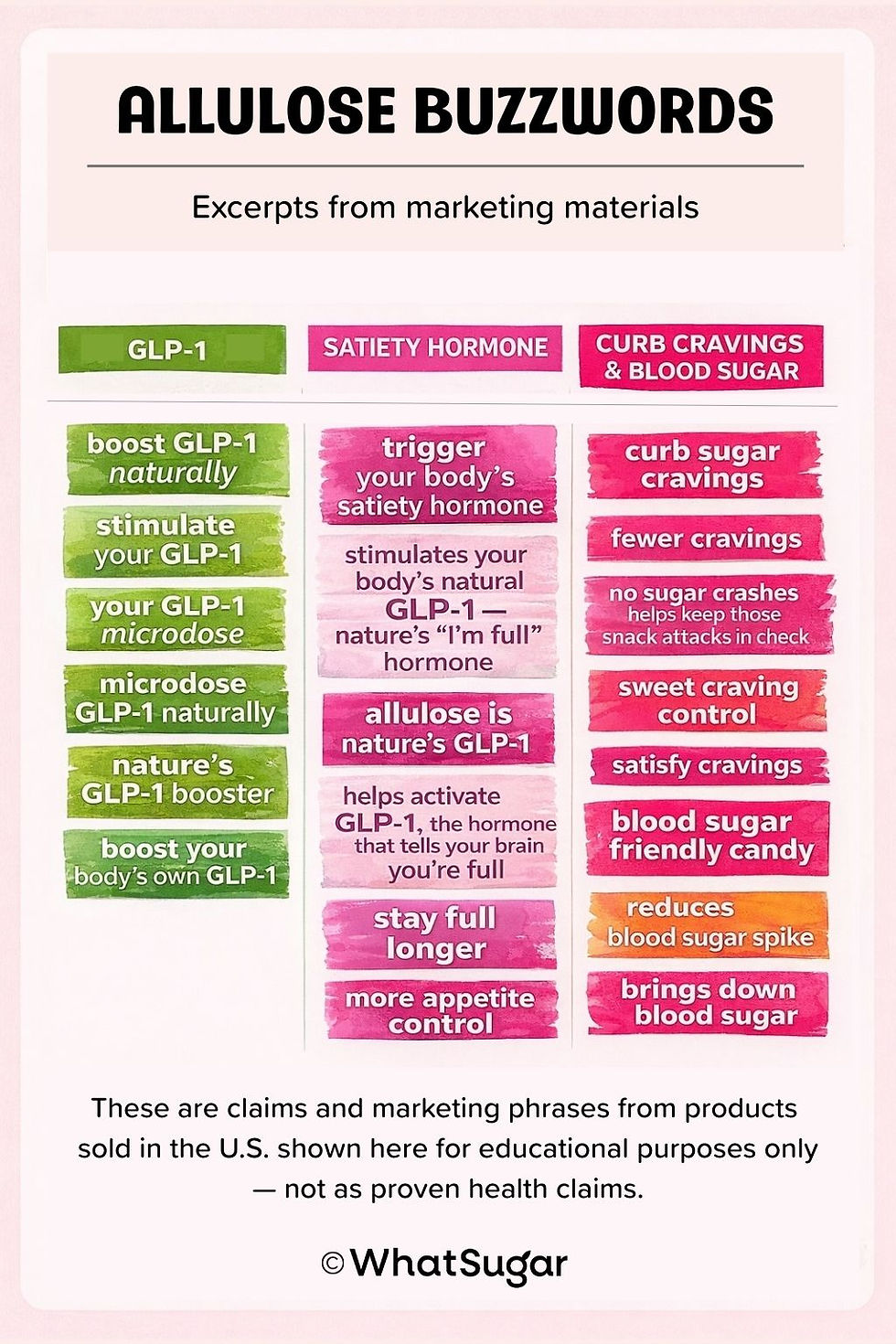
But are they true? Does allulose really work that way? Let’s examine the science and see if allulose really impacts blood sugar, increases satiety, and supports weight loss. The most comprehensive review of human studies to date supports some benefits, but not all the claims you may see online. A 2026 systematic review and meta-analysis of 20 controlled human trials, 12 of them on allulose, found that allulose significantly reduced post-meal glucose and insulin responses. However, it did not significantly improve longer-term measures such as HbA1c, fasting glucose, fasting insulin, blood lipids, or body composition.
So where does GLP-1 fit into all of this?
Does allulose increase GLP-1?
If you're thinking "I don't even know what GLP-1 is," you're not alone. And that’s exactly why I wrote this section: to explain it in plain English.
1) What is GLP-1?
GLP-1 stands for glucagon-like peptide-1. It's a hormone your body naturally produces. After you eat, specialized cells in your small intestine (called L-cells) release GLP-1 as part of a normal digestive response. Here's what GLP-1 does:
- it reduces hunger or appetite
- it increases feeling of fullness
- it helps regulate blood sugar levels. 👉 In simple terms, GLP-1 is a satiety hormone that tells your brain you’ve eaten enough.
2) What is a GLP-1 booster?
A GLP-1 booster is anything that increases the body’s release or activity of GLP-1. Higher GLP-1 levels can lead to feeling fuller longer, slower digestion, and better blood sugar control—which is why GLP-1 has become a hot topic in metabolic health and weight management. 👉 Bottom line: GLP-1 booster = feeling full longer → eating less → weight loss support.
3) What are the benefits of GLP-1 boosters?
Put simply, GLP-1 boosters help two main groups of people: - Those trying to lose weight, by making them feel full longer.
- People with type 2 diabetes (T2D), by improving post-meal blood sugar control. These two effects explain most of the health benefits people associate with GLP-1.
4) How do GLP-1 boosters help people lose weight?
GLP-1 boosters support weight loss mainly because they help people eat less without feeling deprived. They do this in several ways:
GLP-1 boosters increase satiety and reduce appetite. They enhance feelings of fullness and dial down hunger signals, so you’re satisfied with less food.
GLP-1 boosters slow gastric emptying. Food leaves the stomach more slowly, which helps fullness last longer after meals.
GLP-1 boosters improve blood sugar control. They support insulin release and sensitivity, helping prevent sharp blood sugar swings that can drive hunger.
GLP-1 boosters reduce glucagon release. Glucagon works opposite to insulin—it's a hormone that raises blood sugar by releasing sugar from the liver. Lower glucagon levels help prevent excess glucose release and the hunger that often follows blood sugar swings.
5) How to increase GLP-1?
GLP-1 can be boosted in two very different ways: naturally (also called endogenous) as part of normal digestion, or artificially through prescription medications such as GLP-1 receptor agonists.
Allulose is being studied as a potential natural GLP-1 booster, meaning it may encourage your body to release more of its own GLP-1 after eating. Medications like Ozempic work differently. Instead of nudging your body to release GLP-1, these medications bind to and activate GLP-1 receptors directly.
6) What are artificial GLP-1 boosters?
Artificial GLP-1 boosters are prescription medications. The most well-known examples are GLP-1 receptor agonists such as Ozempic, Wegovy, and Mounjaro. Besides slowing stomach emptying, increasing feelings of fullness, and reducing appetite, people also report that these medications reduce "food noise"—a term that has become widely used in recent years to describe the constant mental chatter about food. Then you eat less because you're simply not thinking about food as often.
GLP-1 drugs are far more powerful and longer-lasting than natural GLP-1. They produce GLP-1 effects far beyond what the body produces naturally after eating and remain active for hours to days — and in some formulations, up to a week or longer.
GLP-1 drugs require medical supervision. Because they strongly affect appetite, digestion, and blood sugar, careful management with a healthcare professional is essential.
GLP-1 drugs come with trade-offs and potential side effects. GLP-1 medications can be expensive and commonly cause side effects like nausea, vomiting, and constipation. Weight loss may also include significant muscle loss, and discontinuation rates are high—many people regain much of the lost weight after stopping unless major lifestyle changes are made.
7) How to increase GLP-1 naturally?
“Natural GLP-1 booster” refers to everyday factors that influence how much GLP-1 your own body (endogenous) releases as part of normal digestion.
Natural GLP-1 release is relatively modest and short-lived. It's released when nutrients enter the gut and are broken down within minutes. As digestion continues, new GLP-1 is released in waves, so levels can stay elevated for 2–3 hours after a meal. This is nowhere near the strength or duration of GLP-1 medications.
Wondering what actually helps release GLP-1 naturally? Food directly triggers GLP-1 release, but lifestyle can influence how strong that response is. Here's how: ① Eating & digestion → the strongest and most direct trigger of natural GLP-1
⚖️ Eating balanced, whole meals that include protein, fat, and fiber (from foods like vegetables, fruit, dairy, legumes, and whole grains)
🥦 Starting meals with vegetables or fiber-rich foods can slow digestion and improve satiety signals
🐢 Eating slowly helps as GLP-1 is released as food moves through the gut, and eating too fast short-circuits that signaling
② Exercise → can increase GLP-1 response, especially walking after meals ③ Sleep quality → poor sleep is linked to weaker GLP-1 signaling, weaker appetite signals, and more hunger the next day
④ Weight loss → can improve how responsive the GLP-1 system is ⑤ Gut health → affects how strongly GLP-1 is released after eating
8) Does allulose increase GLP-1 levels?
By now, you're thinking: Where does allulose fit into this? Does it work this way, too? Does allulose make us feel less hungry after using it? Is allulose a GLP-1 booster?
In controlled research settings, allulose has been shown to increase GLP-1 release. After Japanese researchers figured out how to produce allulose using enzymes in the 1990s, they published studies suggesting that allulose could increase GLP-1 release (for example, Hayakawa et al., 2018 and Iwasaki et al., 2018). More recent studies (Cayabyab et al., 2024) have reported similar findings. However, those experiments are based on animals, and our guts release and respond to hormones very differently from those of rats and mice.
Studies on allulose's effects on GLP-1 in humans are still very limited. One short-term human trial (Teysserie et al., 2022) reported increases in GLP-1 and lower self-reported hunger after meals. The experiment is small and designed to assess hormone responses rather than to test whether people eat less or lose weight. A second small human study (Noh et al., 2026) also found that allulose increased GLP-1, although it was industry-funded and did not find a significant increase in satiety.
Experimental doses don’t necessarily reflect how people actually eat allulose in real life. Allulose is often given in large, carefully timed doses. In the first human experiment above, participants consumed 25 g (~6 teaspoons) of allulose dissolved in water directly into the stomach through a nasal tube after an overnight fast. In Noh et al., 10 g (~2½ teaspoons) was taken orally in water immediately before a standardized carbohydrate meal. While more realistic, this was still a deliberately timed experimental dose. These controlled designs help researchers isolate the metabolic effects of allulose, but they don’t necessarily reflect typical use in everyday eating. In addition, large single doses — especially on an empty stomach — may increase the chance of digestive discomfort, which is one reason allulose tends to be self-limiting. If you have too much, your gut lets you know quickly.
Who funds the research matters. Many allulose studies are conducted by research groups closely connected to rare sugar manufacturers or industry partners, with disclosed conflicts of interest. That doesn’t invalidate the findings, but it does mean the results should be interpreted carefully.
So what does this mean for real people? Between the research and hundreds of messages from my readers, there are consistent hints that allulose does more than just sweeten. The available evidence gives us useful clues, but not precise, one-size-fits-all advice. I’ll share what we know so far — and how to apply it in a real kitchen — so keep scrolling to: How much allulose do I need for health benefits?
9) Can allulose work like Ozempic?
No, allulose cannot boost GLP-1 like Ozempic. While allulose may increase GLP-1 under certain conditions, that effect is gentle, modest, and short-lived. GLP-1 medications, on the other hand, produce far more powerful and longer-lasting effects than natural GLP-1.
Can allulose lower blood glucose?
Yes. When you use allulose in foods that normally contain sugar or carbs — like baked goods, desserts, coffee, or tea — it can help keep blood sugar from spiking as much after you eat.
Studies in healthy adults show that using allulose in place of sugar leads to smaller post-meal blood sugar rises. A primary source behind this is a 2023 PLOS ONE meta-analysis (Yuma et al.) that analyzed multiple human trials. These include short-term studies in which allulose was consumed with carbohydrate-containing meals, focused on blood glucose responses. They did not directly measure GLP-1 or test whether people eat less or lose weight. The effects on insulin levels were mixed.
Studies in people with type 2 diabetes also show improved post-meal glucose control when allulose is included in meals. A 2023 crossover trial (Fukunaga et al.) and a 2024 meta-analysis (Ayesh et al.) found lower glucose responses after meals, without increasing insulin demand. The 2023 trial authors suggested a possible role for gut hormones like GLP-1, though this was not directly measured.
So what does this mean in practical terms? The research shows consistent patterns, but it doesn’t give one-size-fits-all instructions. If you’re wondering how much allulose was used in studies — and what that means for real-life use — keep scrolling to: How much allulose do I need for health benefits?
Can allulose help with weight loss?
Yes — it can.
Allulose may help with weight loss because it replaces sugar, lowering total calorie intake. When you substitute allulose for sugar, you reduce overall energy consumption — and that’s what drives weight loss. However, allulose does not guarantee weight loss. If someone treats it as a “free pass” to overeat other high-calorie foods, the calorie savings can disappear. Used correctly, allulose can be a helpful weight-loss tool.
Research also suggests that allulose can trigger GLP-1 release, which could contribute to weight loss, but this effect appears modest compared to calorie reduction, which remains the primary driver. In practice, any observed weight change in people likely results from calorie displacement rather than GLP-1 appetite control.
So how should you think about this at home? Any benefit depends on what it replaces, how it’s used, and what the rest of the meal looks like. If you’re wondering what published studies have reported — and what that might mean in real life — head to the next section, How much allulose do I need for health benefits?
How much allulose do I need for health benefits?
By now, you're probably thinking about how to actually use allulose to support health benefits like lowering post-meal blood sugar or increasing GLP-1 levels. Practical questions I got from readers include:
🤔 How much allulose do I need?
⏰ What’s the best time to use allulose—before, with, or after a meal?
Science is beginning to answer these questions, but there is still a lot to learn. That’s why I’m considering creating a practical guide that translates published research into everyday language and combines it with what I’ve observed from hundreds of readers and customers.
📩 I’d love your input. Would you find a guide like this helpful?
Email me at info@whatsugar.com or click the button below. I read every message, and your feedback and questions help shape what I create next.
.
Is Allulose Keto? Diabetic Friendly? Vegan? Paleo? Bad for IBS? Bad for Dogs?
✔️ Allulose is safe for diabetics as it has no effect on glycemic levels and insulin release.
✔️ Allulose is paleo-diet friendly.
✔️ Allulose is low-carb and ketogenic-diet friendly.
✔️ Allulose is vegan and vegetarian-friendly.
✔️ Allulose is gluten-free.
✔️ Allulose, unlike xylitol, is safe for dogs. ✔️ Allulose is gut-friendly, for those who tolerate it well.
❌ Allulose is not tolerated by everyone.
❌ Allulose is not IBS-friendly.
⚠️ Allulose can be claimed as being FODMAP-friendly. And this creates a false sense of security as people assume it won’t cause digestive symptoms. Here's why:
FODMAP is a widely used acronym (Fermentable, Oligo-, Di-, Mono-saccharides, And Polyols) that describes carbohydrates associated with unpleasant gastrointestinal effects. If you’re unfamiliar with it, this site explains it in simple terms. Allulose behaves similarly to FODMAP; however, as of January 2026, Monash University in Australia — the leading authority on identifying and testing foods for FODMAP content — has not yet tested allulose.
At WhatSugar®, we use the term Low Digestible Sweeteners, to describe fermentable carbs with a sweet taste that may cause digestive issues, even if they aren’t technically classified as FODMAPs. I explain how allulose affects digestion here and here.
What Does Allulose Taste Like?
Sweetness of Allulose vs Regular Sugar
How sweet is allulose? Allulose is sold in two forms:
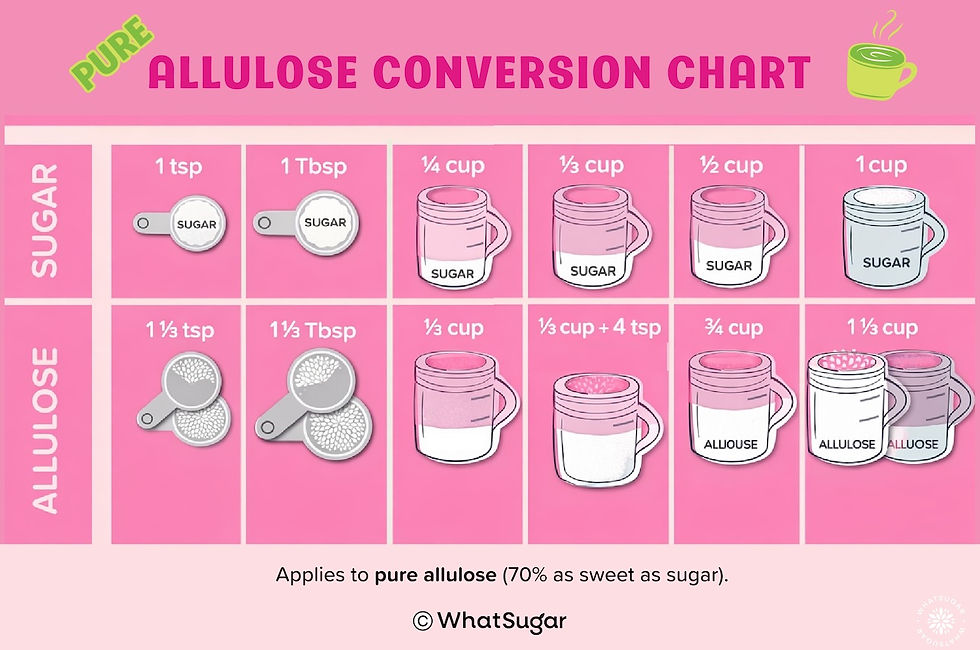
1- Pure Allulose is less sweet than sugar, so you need to use more. If a recipe calls for a cup of sugar, you need at least 30% more of allulose to match sugar’s sweetness level. Taste preference varies, so start with 1 ⅓ teaspoons to replace 1 teaspoon of sugar and add more until you reach your optimum sweetness level. See the conversion chart below.

2- Allulose Blends measure like sugar on a one-to-one ratio, offering the convenience of a direct swap. No need for conversion charts or tricky math. If a recipe calls for a teaspoon of sugar, you simply use a teaspoon of these sweeteners. One cup of sugar? Swap it for one cup of a 1:1 sugar replacement. But before you make the switch, there’s something important you need to know—find out what that is HERE.

Taste and adjust the amount of allulose as you to go. Keep in mind that the perceived sweetness of allulose varies depending on the temperature, pH level, and interaction with other ingredients. Pure allulose needs a bit more to match sugar, while blends are designed to swap 1:1. That's if allulose is simply dissolved in water (at room temperature), but if you add it to your iced tea, hot coffee, lemonade, yogurt, cereal, or fruit, you will need some experimentation to find the right sweetness. Dig deeper and learn why HERE.
Does allulose have an aftertaste?
Allulose (in pure form) tastes almost identical to table sugar, with no aftertaste, but less sweetness. Since it's 70% as sweet as table sugar, you'll need at least ⅓ more to maintain the same sweetness level. Because of allulose's mild sweetness, a popular approach is to blend it with a high-intensity sweetener, like stevia or monk fruit. In fact, most allulose products in stores are actually blends, which lets you keep allulose’s sugar-like texture and baking performance while making it a 1:1 sugar replacement. I compare pure allulose to blends in a series of infographics in my Allulose Buying Guide.
Unlike sugar alcohols — such as erythritol and xylitol — allulose has no cooling effect. This is a cold sensation you feel when sweetener crystals dissolve in your mouth.
Allulose blends can taste different from pure allulose. Although blends often contain predominantly allulose (over 95% by weight), up to 80% of the sweetness can come from a high-intensity sweetener like stevia or monk fruit. Any aftertaste people notice typically comes from that added sweetener—not from allulose itself. That’s why some people say they “don’t like allulose” when what they’re really reacting to is the blend’s other ingredients. You can explore and compare different blends here. ✨ That feedback is part of what led me to develop my own allulose blend. I explain how this shows up in real products later in this post, in the section Which Brand of Allulose Is Best?
Which sweetener tastes more like sugar?
I get that question a lot. If you want to understand what makes allulose or any other sweetener taste good and more like regular sugar, here’s what matters most.
Each sweetener has a distinct taste profile, meaning the sweetness sensation begins, peaks, and lingers differently. This "sweetness intensity over time" refers to how quickly the sweet taste is perceived (registered by our brains) and how long the taste perception lasts in our mouths. When the sweet taste subsides, what is left is called the aftertaste.
Table sugar is still the gold standard, but allulose delivers the sweetness profile — how it hits, peaks, and fades — that comes closest to table sugar. Allulose has a quick onset (the sweetness rises quickly), a smooth peak, and a clean finish.

How to Use Allulose?
Allulose isn’t exactly cheap to experiment with. That’s why I put those tips together—to help reduce waste and guesswork — and prevent disappointment.
You can typically use the same amount as table sugar to achieve desired results in your recipes. However, if you use pure allulose, you result will be less sweet. With pure allulose remember it is 30% less sweet than table sugar. Therefore, it is recommended to use at least 1 ⅓ cups of allulose to replace one cup of sugar. Refer to the bright pink conversion chart above or if you're comparing with other sweeteners, use my Sweetener Calculator™. Allulose blends are formulated to be as sweet as sugar, so they replace sugar 1-to-1 by volume (cup-for-cup or spoon-for-spoon), which is super convenient.
Once you understand the sweetness, the next important piece is the form it comes in.
Granulated, Powdered, or Brown Allulose: What’s the Difference?
Most allulose sold in stores is granulated and looks very similar to table sugar. Some brands also offer powdered allulose, meant to replace powdered sugar, and brown allulose blends, designed to replace brown sugar in recipes. The difference comes down to crystal size, formulation, and intended use.
Wondering which one you should buy? My 2026 Guide to Buying Allulose compares all the forms of allulose available in stores, but here's the scoop:
What is granulated allulose?
Granulated allulose may also be labeled as granular or crystalline allulose.
Crystals similar to table sugar → heavier per cup than powdered
Best all-purpose option for baking, cooking, and everyday use
Most widely available in stores, as you can see HERE.
What is powdered allulose?
Powdered allulose is also labeled as confectioners' allulose. I compare products side by side in my 2026 Guide To Powdered Sugar Replacements.
Designed to replace powdered (confectioners’) sugar
Finer crystals dissolve faster and give smoother textures
Best for frostings, glazes, cheesecakes, and cold drinks
Availability is limited compared to granulated forms
You can easily make your own, as I explain in my Sugar Swap Starter Kit.
What's brown allulose?
These allulose blends have a soft, moist feel—similar to light brown sugar, which has less molasses than dark brown sugar. I compare products side by side in my 2026 Guide To Brown Sugar Replacements.
Formulated to replace light brown sugar
Typically granulated allulose + molasses or glycerin
Adds moisture and caramel-like flavor
Best for cookies, bars, sauces, and recipes that call for brown sugar
It's super easy to make it at home, as show in my Sugar Swap Starter Kit.
What's allulose syrup?
Allulose syrup is available in a pure form (one ingredient only) and is less sweet than sugar. Blends with high-intensity sweeteners like stevia extract, monk fruit extract, or sucralose are usually 1-to-1 sugar replacements. You can see how syrups stack up side-by-side HERE.
Easy to mix, dissolving instantly in iced cold or hot beverages
Great to add moisture and help prevent dryness in baking recipes
Makes gooey cookies and energy bars
Baking recipes need to be adjusted, as the liquid form can throw off the texture
Shorter shelf life than the other forms.

Allulose crystals: Appearance and behavior
Regardless of whether allulose is sold as granulated, powdered, or in brown sugar blends, the core physical properties of allulose crystals remain the same.
Allulose crystals are naturally white, brilliant, and odorless. When allulose crystals are dissolved in water, a clear, low-viscosity, colorless (or slightly yellow) solution results.
Allulose dissolves exceptionally well in water, even faster than table sugar. That makes it perfect for drinks and cocktails. By comparison, at room temperature:
🎯 Allulose: dissolves easily, up to 291 g in 100 g of water (74% w/w). 📌 Table sugar: less soluble, tops out at about 200g in 100g of water.
Allulose and fructose crystals behave similarly in the kitchen.
Because they both hold on to moisture, melt and brown at similar temperature ranges, fructose and allulose often behave very similarly in real cooking and baking. Remember that fructose is one of the two sugars that make up table sugar—so this behavior isn’t unusual.
Allulose crystals, like fructose, are hygroscopic. It means that if allulose is left exposed, it will absorb moisture from the air. When left exposed, the crystals can lose their dry, free-flowing structure and become sticky, compacted, or partially dissolved. That’s why airtight storage is especially important in humid environments.
Allulose crystals melt at a much lower temperature than table sugar. That means allulose turns into liquid much sooner when heated. Table sugar, by contrast, has a much higher melting point, which is why it is more stable in its granulated form compared to allulose and fructose. 🎯 Allulose melting point ≈ 227°F (108°C).
🄵 Fructose melts at ~236°F (114°C) 📌Table sugar melting point ≈ 340°F (171°C).
Like fructose, allulose browns at lower temperatures than table sugar (though allulose is not quite as low as fructose). Browning refers to caramelization and related chemical reactions that create color and flavor. Because these reactions start earlier for fructose and allulose, they promote faster browning—but also explain why baked goods made with allulose (and honey) may stay softer rather than crisp. Allulose can begin browning around ~212–230°F (100–110°C).
🄵 Fructose browns around ~230°F
🎯 Allulose browns around ~240–250°F
📌 Sugar browns much later, ~320–340°F (160–170°C)
Why and when it matters for home cooks in real kitchens: These properties explain why you need to play with things like oven temperature and baking times—and why small adjustments can make a big difference. I break down what to change and when in the Sugar Swap Starter Kit.
Is Allulose Expensive?
Compared to table sugar, yes. But once you understand how allulose is made — and how few companies produce it, the price starts to make sense. Allulose delivers sugar-like taste and performance — without sugar, calories, and impact on blood glucose levels. For many people, those benefits alone justify the cost. Any potential health benefits are a bonus — a nice extra. As I write this (January 2026), here's what I found:
Allulose often costs 10× more than table sugar. When an ingredient costs that much, knowing how to use it well matters. That's why I created the Sugar Swap Starter Kit — to show you exactly how to use it well—so you don’t waste time and money.
The cost of a pound of pure allulose ranges from $10 to $18 in stores across the United States. Bulk buyers pay far less (often under $10/lb). Small packages land closer to $15–18/lb. To compare, table sugar averages $1.05 per pound and its even sweeter than allulose, so you use less.
When matched for sweetness, pure allulose is roughly 14×–25× more expensive than sugar. Since allulose is about 70% as sweet, you need roughly 1.4× more to match sugar’s sweetness—driving up the cost per “sugar-equivalent” sweetness. In real kitchens, that translates to paying about $6–$11 to replace 1 cup of sugar with pure allulose, versus roughly 50 cents for sugar.

Certified organic allulose prices range from $13 to $17 per pound. As discussed earlier in Is It Worth It to Buy Organic Allulose?, that small price difference buys documented sourcing, non-GMO ingredients, and stricter oversight—verifiable safeguards throughout the supply chain.
If pure allulose feels expensive, blends are often the smarter buy. Pure allulose is about 70% as sweet as sugar, so you need more of it to achieve the same level of sweetness. Blends solve that problem. Allulose blends are formulated to be as sweet as sugar, so they replace sugar 1-to-1 by volume (cup-for-cup)—making them far more cost-effective for everyday use. Here’s why blends usually offer better value:
⚖️ Blends are as sweet as sugar, so you don’t need 30–40% more like you do with pure allulose. No extra required.
🧁 Blends simplify baking and cooking as no conversion is needed. Simply replace the amount of sugar called for in the recipe.
🌿 Most blends combine allulose with monk fruit and/or stevia, boosting sweetness but keeping sugar-free and zero-calorie.
💰 Because you use less product overall, the cost of blends per “sugar-equivalent” cup is often much lower than pure allulose.
Cost of allulose blends in store shelves tends to vary from $8–$12 per pound, with price largely driven by the added sweeteners. Most blends pair allulose with monk fruit and/or stevia, while blends with erythritol are usually cheaper. Some come with vague “natural flavors” to fine-tune allulose's sweetness level. Because these blends vary so much, I put together a 2026 Allulose Buying Guide that walks through the top blends currently sold in the U.S.
I hear this concern about price all the time. Allulose isn’t cheap — especially if you care about sourcing, quality, and organic certification. ✨ That price frustration is what shaped my decision to develop my own blend. I explain how this shows up in real products later in this post, in the section Which Brand of Allulose Is Best?
Which Brand of Allulose is Best?
Once I started comparing allulose products side by side, one thing became clear: the biggest differences between brands aren’t obvious at first glance—on either the front or back label. What truly sets brands apart shows up in sourcing transparency, formulation choices, and whether a company is willing to stand behind its product with clear information.
What to look for in any allulose brand
Here are five practical checks to make when choosing an allulose brand — and how to tell the trustworthy from the questionable in under 60 seconds:
Clear sourcing information: Where is it made? From what? Reputable brands answer these questions plainly, not buried in fine print or avoided altogether. If sourcing details are hard to find — or if the label relies on vague or misleading phrases like “made from figs, raisins, or jackfruit” — that’s a sign to look elsewhere.
A real company behind the product: Look for a real website, a physical business address, and accessible customer support — not just an Amazon storefront. You should be able to identify who is behind the product and how to reach them if questions or issues come up. If the “About” page is vague, has just a mission statement, or reads like generic marketing copy, that’s a red flag. So is contact information that amounts to nothing more than a web form — with no physical address, no phone number, and no identifiable people associated with the company.
Transparent formulation: If it’s an allulose blend, the brand should clearly say so. If the product is marketed as allulose but the main ingredient is erythritol—or it’s promoted as stevia or monk fruit while those appear last on the ingredient list—that's a signal to be cautious.
Watch for blends that rely on vague language, emphasize fruit imagery, or answer ingredient questions with “it's a proprietary blend." Ingredient amounts can be proprietary, but ingredient names should always be disclosed (unless it's natural flavors, which may be listed without further detail).
Certification vs. marketing claims: On labels, there’s a real difference between certifications and marketing symbols — a row of badges like natural, plant-based, non-GMO, or clean ingredients. For allulose, organic certification matters because it subjects the ingredient to stricter rules and documented oversight at every step — from how it’s made to how it’s handled. Non-GMO Verified is not a substitute for organic certification; the two mean very different things. When buying conventional allulose, the three checks listed above — transparency about sourcing, formulation, and the company behind the product — become even more important.
When shopping in big marketplaces like Amazon, take the time to verify the seller: Because these platforms host thousands of third-party sellers and random resellers, the product listing alone doesn’t tell you who is actually behind the product. Taking a moment to evaluate the brand outside the platform, following the steps listed above, helps separate trustworthy products from questionable ones.
This is why I created my own brand
After testing countless allulose products in stores and writing about them, many at the WhatSugar® community encouraged me to create my own sweetener. They want to know what they’re using, where it comes from, and who’s behind it — so they don’t have to worry about the issues outlined above. This feedback is what ultimately led to the WhatSugar® Organic Allulose + Monk Fruit Blend, launching in 2026. It will be available in both bulk and single-serve packets, offering balanced sweetness with simple, transparent ingredients — without cutting corners.
The Two WhatSugar® Sweeteners
1. WhatSugar® Organic Allulose + Monk Fruit (1:1 Sugar Alternative)
I created the version I trust most: an organic allulose + organic monk fruit blend designed to taste clean and neutral — just like sugar. This is the definition of the best taste: the one you barely notice. Why choose this blend:
👅 Absolutely no aftertaste. Well-rounded taste.
⚖️ Measures like sugar, one-to-one. No guesswork.
✅ All-purpose and reliable, including in baking.
📊 No calories. Zero net carbs. 0g of sugar.
🤝 Certified organic, non-GMO.

☕ WhatSugar® Organic Allulose + Monk Fruit Packets
For people who want zero measuring and full consistency, I created individual packets. One packet replaces 2 teaspoons of sugar — perfect for coffee, tea, and on-the-go use.
Why choose packets:
👌 Portion-controlled. No measuring. 1 pkt = 2 tsp sugar.
👅 Absolutely no aftertaste. Well-rounded taste.
✅ Perfect for on-the-go, coffee, or tea.
📊 No calories. Zero net carbs. 0g of sugar.
🤝 Certified organic, non-GMO.

And if you want the best balance of organic sourcing, clean taste, and real transparency — that’s the standard I’m building toward with WhatSugar®. Our blends launch in 2026 and you can get on the waitlist by emailing me at info@whatsugar.com. If you want to explore the allulose blends currently sold in stores, check out my Allulose Buying Guide.
Takeaway
Pros of Allulose
✅ A natural sweetener as it's "derived from a natural source" and "is found in nature"
✅ Looks and tastes a lot like table sugar; allulose itself has no aftertaste. Really!
✅ Makes the taste of other sweeteners, like stevia and monk fruit, more "sugar-like"
✅ Dissolves easily; even faster than table sugar
✅ Unlike erythritol, it doesn't recrystallize in cold temperatures and has no cooling effect
✅ A zero-calorie sweetener because most of the amount we ingest is not metabolized
✅ Zero glycemic index as it's not metabolized into glucose; no impact on blood sugar
✅ Zero "net carbs" as it offers 4g of non-digestible carbohydrates per serving (4g)
✅ Tooth-friendly as it cannot be fermented by bacteria that cause cavities ✅ Depending on how you use it, it may help reduce post-meal blood sugar spikes.
Cons of Pure Allulose
👎 Pure allulose is not a 1:1 sugar replacement: It is about 30 percent less sweet than table sugar, so expect to add 1 ⅓ times as much to get the same sweetness.
👎 Hygroscopic: You can’t leave it out in a sugar bowl. When exposed to air, allulose absorbs moisture, causing the crystals to lose their dry, free-flowing texture and become sticky or clumpy over time.
👎 Digestive issues: Be prepared for possible digestive discomfort, especially if you over-consume, ingest quickly in concentrated form, or eat by itself on an empty stomach.
👎 It melts and browns differently than table sugar: Browning may happen too fast and give you a too-dark result, and even taste a little burnt. Allulose may result in very soft baked goods and fragile cookies.
👎 Cost: Pure allulose costs 14 to 24 times more than table sugar when you factor in that sugar is sweeter, so you use less. Table sugar averages $1 per pound, while allulose ranges from $8 to $18 per pound. ⭐ No sugar alternative is perfect, but if your priority is something that tastes and behaves like regular sugar, allulose is one of the closest options available today — and for many home cooks, that’s what makes it worth the price.
Questions for you:
I’d love to hear your experience. Email me at info@whatsugar.com and let me know:
Have you tried allulose yet? How have you been using it? Does allulose make you feel less hungry after using it? Fewer cravings?
I’m always curious how it’s working (or not) for folks in real kitchens.
...............
About WhatSugar®: Here, we go beyond the labels, buzzwords, and marketing claims to give you the clear, unbiased answers. I use my background in chemical engineering and food technology to help home cooks choose sweeteners based on evidence—not hype—so they can find what truly fits their lifestyle and goals.
WhatSugar® is supported by a wonderfully diverse community of 5,000+ engaged subscribers and 35,000+ monthly visitors. What unites them is simple: they don’t want to give up sweet taste. Some manage health conditions such as diabetes, cardiovascular disease, and other metabolic issues. Others are focused on weight loss or following a specific diet. And many just want to reduce sugar without feeling deprived. My job is to make that easier.
I built WhatSugar® to examine the full picture of sweeteners.
...............


I found your review of allulose fascinating, especially the details on its impact on blood sugar levels. I'm curious about how it compares to other low-calorie sweeteners when it comes to taste and digestive effects. Have you noticed any differences with prolonged use? Thank you for this insightful analysis!